How to Start Your Own Food Product Line Successfully in Today’s Competitive Manufacturing Landscape?
April 15, 2026
Starting your own food product line is a structured industrial journey that transforms an idea into a repeatable manufacturing system capable of consistent output, regulatory compliance, and scalable profitability. It is not simply about creating a recipe, but about building a complete production ecosystem that includes formulation engineering, equipment selection, process automation, quality control, and distribution planning. For B2B decision-makers, success depends on how efficiently the product can move from concept to a stable, certified, and scalable production line that meets market demand without sacrificing consistency or safety.
In practical terms, understanding how to start your own food product line means understanding how to industrialize food production rather than treat it as a small-batch or artisanal process.
Market Research and Strategic Product Positioning
Every successful food product line begins with a clear understanding of the target market. Market research defines not only what to produce but also how to position it in terms of pricing, packaging, compliance, and distribution channels.
For example, a frozen snack product aimed at supermarket chains will require different cost structures, packaging durability, and shelf-life requirements compared to a health-focused organic snack designed for niche retail or export markets.
Market Segmentation Considerations
Food product lines generally fall into three major B2B-oriented categories:
- Mass retail products focused on volume efficiency
- Premium branded products driven by differentiation and quality perception
- OEM/private label production for distributors and supermarket chains
Each segment directly influences production technology, automation level, and factory design. Misalignment at this stage often leads to inefficiency in scaling and reduced profitability later.
Product Development and Industrial Food Formulation Engineering
Once positioning is defined, the next step is product formulation. Unlike home or lab recipes, industrial food formulation must account for thermal stability, mechanical processing behavior, and long-term storage performance.
For example, sauces and emulsified products behave differently when exposed to continuous heating and high-speed mixing systems. Similarly, baked or extruded products may change texture when scaled to industrial throughput.
This is where collaboration with engineering-driven manufacturers becomes essential. Integrating expertise from food processing industry machinery helps ensure that formulations are compatible with real production environments rather than theoretical models.
Food Factory Design and Equipment System Integration
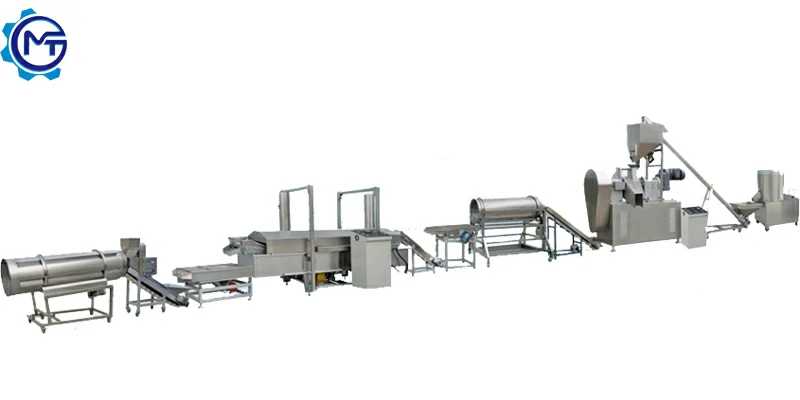
A modern food production system is built as a fully integrated workflow rather than isolated machines. This includes raw material preparation, processing, forming, sterilization, and packaging systems working in synchronization.
Below is a structured overview of core industrial equipment stages used in food manufacturing:
| Production Stage | System Type | Industrial Function |
|---|---|---|
| Raw Material Preparation | Cleaning, sorting, lifting systems | Ensure ingredient purity and consistency |
| Core Processing | Mixing, grinding, cooking systems | Convert raw materials into product base |
| Forming & Shaping | Extrusion, molding equipment | Define final product structure |
| Thermal Processing | Sterilization, baking, frying units | Ensure food safety and shelf stability |
| Packaging System | Filling, sealing, labeling machines | Final retail or wholesale packaging |
Table 1: Industrial food production line system structure
A properly designed food processing production line ensures continuous output, reduced labor dependency, and stable product quality across batches, especially in large-scale manufacturing environments where consistency is critical.
Working with engineered food processing production line systems allows manufacturers to scale efficiently while minimizing production variance and downtime.
Compliance, Certification, and Food Safety Engineering
Food manufacturing is highly regulated, and compliance is a core design requirement rather than a final inspection step. Depending on the target export market, manufacturers must comply with standards such as HACCP, ISO 22000, FDA regulations, and EU food safety directives.
Compliance affects:
- Factory layout design
- Equipment material selection
- Cleaning and sterilization systems
- Documentation and traceability systems
For example, high-moisture food production requires stricter microbial control systems compared to dry snack production, influencing both machinery selection and production environment design.
Engineering-grade food processing industry machinery is designed to support these compliance requirements from the start, reducing certification delays and operational risks.
Cost Structure, Investment Planning, and ROI Strategy
Building a food product line requires a clear financial model that includes capital expenditure, operating costs, and expected return on investment. Equipment investment typically represents the largest upfront cost, followed by facility construction and compliance certification.
However, automation plays a key role in long-term cost optimization. Higher automation levels reduce labor dependency, improve production consistency, and lower defect rates, which directly improves profit margins over time.
In many industrial cases, companies adopt a phased investment strategy:
- Phase 1: Pilot production line for validation
- Phase 2: Semi-automated expansion for market entry
- Phase 3: Full-scale automated production system
This staged approach reduces financial risk while allowing market validation before large-scale capital commitment.
Supply Chain Strategy and Distribution Network Development
A food product line does not end at manufacturing. Supply chain design determines how efficiently products reach distributors, retailers, or end consumers.
Key elements include:
- Raw material sourcing stability
- Cold chain logistics (if required)
- Warehouse and inventory management
- Export documentation and compliance handling
For many B2B brands, OEM and private label manufacturing models provide faster market entry because production complexity is outsourced while branding and distribution are handled internally.
Companies often rely on experienced food processing machinery suppliers to not only provide equipment but also assist in factory layout and system integration for smoother scaling.
Scaling from Pilot Production to Full Industrial Output
Scaling is one of the most challenging stages in food manufacturing. A product that performs well in small batches may behave differently under continuous industrial production due to heat transfer changes, ingredient interaction variations, and mechanical stress in processing systems.
A structured scaling model typically includes:
- Laboratory formulation development
- Pilot production validation
- Semi-industrial trial runs
- Full-scale industrial production deployment
Each stage reduces uncertainty and ensures that product quality remains stable when production volume increases significantly.
Quality Control Systems and Shelf-Life Optimization
Quality control in food manufacturing includes physical inspection, chemical testing, and microbiological analysis. Modern production lines often integrate inline monitoring systems to detect deviations in real time.
Shelf-life stability is influenced by:
- Moisture content
- Packaging barrier properties
- Preservative systems
- Storage environment conditions
A robust production system ensures that quality remains consistent from the first unit to the last unit in every batch, which is essential for export-grade food products.
Frequently Asked Questions (FAQ)
1. How do I start my own food product line with limited experience?
You can start by partnering with OEM manufacturers and focusing on product concept validation before investing in your own production facility.
2. What is the most important factor in food product line success?
Consistency in production quality and scalability of manufacturing systems are the most critical success factors.
3. Do I need a factory to start a food product line?
No. Many brands begin with contract manufacturing before building their own facilities once demand is stable.
4. How long does it take to launch a food product line?
Typically 3 to 12 months depending on product complexity, equipment setup, and regulatory approvals.
5. What certifications are required for international food sales?
Common certifications include HACCP, ISO 22000, FDA compliance, and EU food safety standards.
About Meiteng
Meiteng is a professional food product line supplier specializing in designing and manufacturing integrated food production systems for global clients. With expertise in automation, process engineering, and industrial scaling, Meiteng supports food manufacturers in building efficient, compliant, and scalable production lines. From concept development to full factory implementation, Meiteng delivers end-to-end solutions tailored to modern food manufacturing demands.
References
- FAO Food Safety and Quality Guidelines: https://www.fao.org/food-safety/en/
- World Health Organization Food Safety: https://www.who.int/health-topics/food-safety
- U.S. FDA Food Guidance: https://www.fda.gov/food
- ISO 22000 Food Safety Management Systems: https://www.iso.org/iso-22000-food-safety-management.html