How Precise Temperature Control Enhances the Textural Stability of Extruded Foods?
July 8, 2026
In the modern commercial food manufacturing industry, texture is a critical benchmark for product success. Whether it is the airy crunch of a puffed snack, the satisfying snap of a breakfast cereal, or the fibrous chew of a plant-based meat analogue, the physical sensation of eating dictates consumer loyalty. In food extrusion cooking, temperature isn’t just a basic setting; it is the primary driver of the complex physical, chemical, and rheological transformations that dictate final product quality. A slight temperature deviation can mean the difference between a light, crispy product and one that is tough, chewy, or unpleasantly dense.
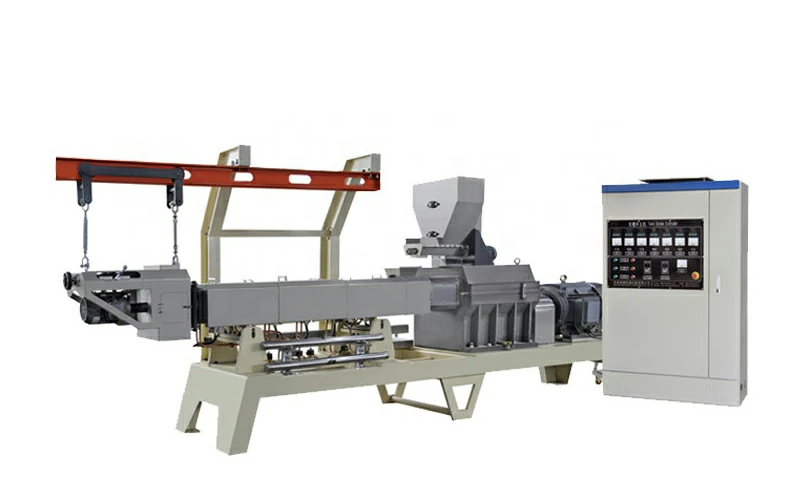
For manufacturers looking to dominate the competitive snack and food market, investing in a high-quality food extruder with advanced thermal regulation is non-negotiable. At Meiteng Machinery, we understand that precise temperature control is the ultimate secret weapon for maintaining long-term textural stability. It ensures that the very first batch rolling off the production line perfectly matches the last in crunch, snap, appearance, and shelf-life.
Controlling Macromolecular Transformations
Extruded foods rely heavily on the structured rearrangement of molecular biopolymers—mainly starches and proteins. The raw ingredients inside a food extruder machine undergo intense thermal and mechanical energy input, changing their state completely within seconds.
- Starch Gelatinization: In the production of popular expanded snacks using a corn extruder machine, starch must absorb water and heat to undergo complete gelatinization. If the processing temperature is too low, under-gelatinization occurs, leaving raw starch granules intact and leading to a gritty, hard, and sandy texture that consumers dislike. Conversely, if the temperature peaks too high, the starch over-degrades (a process known as dextrinization). This breaks down the molecular chains excessively, causing a complete loss of structural integrity and resulting in a soggy, fragile, or sticky texture.
- Protein Denaturation: For advanced applications like Textured Vegetable Protein (TVP) and high-moisture meat analogues, precise heat profile management is required to unwind and cross-link proteins into fibrous, meat-like strands. Using a sophisticated snack food machinery extruder, a temperature shift of just 2°C to 3°C can completely disrupt protein alignment. Instead of a chewy, cohesive, and juicy bite that mimics real meat, you end up with a crumbly, mushy, or completely unmarketable product.
Managing Melt Viscosity and Pressure Dynamics
Inside the barrel of a food extruder, the raw food mix behaves as a highly non-Newtonian fluid. This means its viscosity is not constant; rather, it is extremely sensitive to both mechanical shear and thermal fluctuations.
When the temperature inside the barrel varies, the melt viscosity fluctuates wildly. If the viscosity drops too low due to overheating, the material flows too quickly through the die, lacking the resistance needed to build internal pressure. If the temperature drops, the melt becomes too viscous, placing immense mechanical strain on the extruder screw and motor, leading to uneven surging at the discharge die.
Meiteng Machinery integrates multi-zone independent heating and cooling systems into every food extruder machine. This tight temperature control stabilizes the melt viscosity, ensuring a perfectly uniform flow rate and a consistent volumetric density across hours of continuous operation.
Optimizing Flash Evaporation and Bubble Growth
The legendary “crunch” of an extruded snack happens the precise millisecond the molten material exits the die plate. Because the barrel of a corn puff extruder machine operates under intense pressure and high temperature (often well above 100°C), the internal water is kept forcefully in a liquid state. The moment the product hits atmospheric pressure outside the die, that superheated water instantly flashes into steam, expanding rapidly to create millions of microscopic bubbles.
- The Cell Wall Balance: If the temperature at the die zone is perfectly controlled, the gelatinized starch matrix stretches just enough to accommodate the expanding steam bubbles without popping them. This creates an ideal, uniform, open-cell micro-structure that delivers an premium, airy crispiness.
- The Danger of Fluctuations: If the die temperature drops even slightly, the starch matrix hardens too quickly before the steam can fully expand, resulting in low expansion ratios and a dense, hard, tooth-breaking bite. If it’s too hot, the cell walls become too thin, weak, and rupture instantly, causing the entire expanded structure to collapse into a dense, hard, unappealing flake.
Preventing Starch Retrogradation (Long-Term Shelf-Life Stability)
True textural stability isn’t just about how the food tastes immediately after cooling; it’s about how it tastes after sitting on a retail shelf for three, six, or twelve months.
Once the extrusion process is complete and the food cools down, the disordered starch molecules naturally try to re-align, recrystallize, and return to their original structured state—a biochemical phenomenon known as retrogradation. Retrogradation is the direct cause of product staling, moisture migration, and unwanted hardening.
Achieving precise thermal cooking inside a snack food machinery extruder ensures the complete and uniform melting of both amylose and amylopectin crystals. This uniform, thorough disruption of the native starch structure significantly slows down the subsequent rate of retrogradation during storage. By controlling the heat profile with absolute precision, Meiteng Machinery ensures your snacks retain their target crispiness or softness throughout their entire designated shelf life, preventing premature staling and reducing waste.
Why Global Manufacturers Trust Meiteng Machinery?
Achieving this level of thermal precision requires more than just standard heaters. Meiteng Machinery engineers its advanced food extruder machine lines with state-of-the-art PLC automation, independent barrel zoning, and highly sensitive PID temperature controllers coupled with rapid-response water cooling jackets.
Whether you are running a high-capacity corn extruder machine for regional distribution or utilizing a specialized corn puff extruder machine for innovative, multi-flavored snacks, Meiteng provides the technological backbone needed to stabilize your product’s texture, maximize your raw material yield, and ensure repeatable, top-tier quality in every single batch.
Partner with Meiteng Machinery today to elevate your food production capabilities and deliver the perfect bite to your consumers every single time. Visit our official website to explore our comprehensive range of high-efficiency food extruder solutions.