Augmented Reality and ‘Total Control’ over the Cereal Process: The Sensitivity of Starch
July 13, 2026
In the highly competitive breakfast cereal and puffed snack manufacturing industries, achieving product consistency is a daily battle. Consumers expect the exact same crunch, texture, and bowl-life from every box. However, the core raw material behind these products—starch—is a highly volatile, sensitive biopolymer that responds drastically to the slightest variations in temperature, moisture, and mechanical shear.
For decades, plant managers relied on manual sampling and operator intuition to manage starch gelatinization. Today, a digital transformation is unfolding. By pairing Augmented Reality (AR) with real-time IoT sensor data, manufacturers are achieving “Total Control” over the extrusion cooking process, turning the unpredictable sensitivity of starch into a precisely engineered science.
The Core Challenge: Understanding the Extreme Sensitivity of Starch
To understand why “Total Control” is necessary, one must understand the behavior of starch during extrusion cooking. Whether processing corn, wheat, rice, or oats inside a modern cereal production line, starch undergoes a profound structural transformation:
- Gelatinization & Melting: Under thermal energy (heat) and mechanical shear (screw rotation), the semi-crystalline starch granules absorb water, swell, and irreversibly disrupt their crystalline structure.
- Viscosity Shifts: As gelatinization peaks, the viscosity of the dough inside the extruder barrel spikes dramatically, then rapidly drops as the molecular chains (amylose and amylopectin) begin to degrade or “dextrinize.”
- The Expansion Window: The success of the final cereal puff relies on a razor-thin window of optimal melt elasticity and pressure right at the extruder die.
If the barrel temperature fluctuates by even 2°C to 3°C, or if the raw flour moisture varies by 1%, the starch matrix will either under-cook (resulting in dense, hard, unexpanded pieces) or over-cook (resulting in fragile, collapsed structures that break down in milk).
Enter Augmented Reality: Visualizing the “Invisible” Inside the Extruder
The primary historical limitation of extrusion processing has been that the extruder barrel is a closed, pressurized system. Operators cannot see the starch transformation happening in real-time. They can only monitor data on a distant HMI screen or wait for the physical product to exit the die—by which time hundreds of kilograms of out-of-spec product may have already been produced.
Augmented Reality bridges this gap by acting as an interactive, real-time window into the machine. Here is how AR empowers operators with “Total Control”:
1. Real-Time Holographic Process Overlays
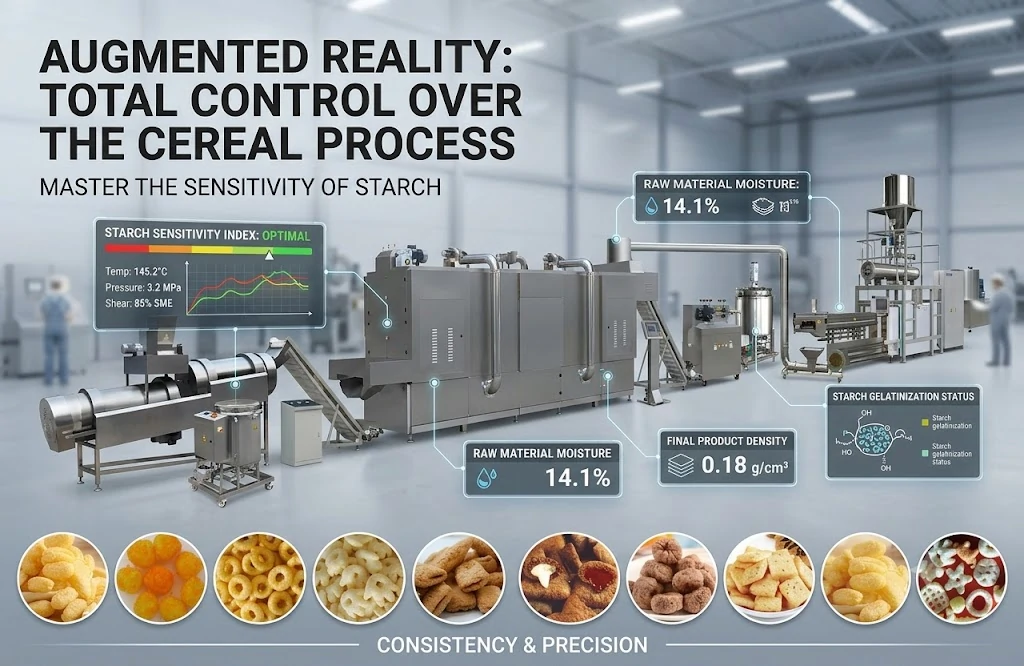
Equipped with AR smart glasses or industrial tablets, a technician walking the factory floor can look directly at a twin-screw extruder and see a live, holographic visualization of the process data superimposed onto the physical hardware.
- They can see a color-coded thermal profile of each barrel zone.
- They can view live graphs of Specific Mechanical Energy (SME) and melt pressure directly above the die head.
2. Predictive Starch Behavior Modeling
Advanced AR platforms don’t just display historical sensor data; they integrate with AI-driven digital twins. Based on current moisture, screw speed, and feed rate, the AR interface can project a predictive curve of the starch gelatinization phase inside the barrel. If the system detects that the starch is tracking toward dextrinization (over-cooking), the AR system flags a visual alert before the product is ruined.
3. Accelerated Troubleshooting and Guided Adjustments
When a variance occurs, the AR system guides the operator through precise corrective actions. For example, if the starch matrix requires a slight reduction in shear, the AR display can visually highlight the exact water-injection valve or screw-speed dial on the physical machine, providing step-by-step instructions to stabilize the process without shutting down production.
Achieving “Total Control”: The Synergy of Data and Physics
True “Total Control” over the cereal process relies on combining the spatial visualization of AR with closed-loop automation adjustments:
- Closed-Loop Moisture Alignment: NIR (Near-Infrared) sensors continuously measure the moisture of the incoming flour. If a fluctuation is caught, the automation system tweaks the pre-conditioner water flow, while the AR system alerts the operator to ensure the starch gets perfectly hydrated.
- Dynamic Shear Management: By monitoring real-time motor torque alongside AR-driven viscosity models, the system can modulate screw speeds dynamically, keeping the mechanical degradation of starch within strict boundaries.
The Business Value: ROI of AR-Driven Cereal Processing
Implementing Augmented Reality and advanced process controls for starch management delivers clear, measurable B2B advantages:
- Drastic Reduction in Scrap Rates: Catching starch variances inside the barrel prevents thousands of pounds of out-of-spec cereal from ever reaching the dryer.
- Minimized Downtime during Product Changeovers: Transitioning from a high-density bran cereal to a delicate puffed corn snack requires entirely different starch-cooking parameters. AR-guided setups allow operators to hit optimal parameters faster.
- Enhanced Workforce Training: Experienced extrusion operators are rare. AR-guided systems institutionalize expert knowledge, allowing less experienced technicians to manage highly sensitive starch formulations safely and effectively.