How Can the Right Pet Food Processing Equipment USA Systems Elevate Your Production Quality and Plant Output?
June 17, 2026
Investing in high-performance pet food processing equipment usa solutions elevates your production quality and plant output by providing precise thermal control, consistent ingredient mixing, and optimized starch gelatinization. Modern companion animal diets require highly specific nutritional profiles, delicate structural textures, and attractive visual shapes to satisfy strict commercial standards. Implementing a modern, automated production array directly addresses these market parameters by reducing operational material waste, ensuring formula uniformity, and increasing continuous extrusion speeds. Sourcing your specialized manufacturing infrastructure from a dedicated technical partner allows processing facilities to scale up their daily operational throughput, lower total utility usage, and maintain exact batch repeatability across various complex ingredient recipes.
Consider a practical manufacturing scenario within a busy premium kibble factory handling multi-ingredient formulas. If a facility attempts to process high-meat recipes using outdated mechanical extruders, small fluctuations in barrel temperature or inconsistent steam injection can cause uneven starch expansion. This operational variance results in brittle kibble that crumbles during packaging, leading to high product rejection rates and decreased plant profitability. Upgrading to a specialized pet food processing equipment usa system solves this issue by integrating advanced twin-screw extrusion mechanics and automated thermal monitoring zones. For instance, a manufacturing plant can maintain a steady processing climate to eliminate product crumbling completely, allowing the operation to increase its hourly packaging volume while protecting formula integrity.
Engineering Standards for Starch Gelatinization and Texture Control
Processing high-quality dry kibble requires deep technical knowledge of starch gelatinization under high-temperature short-time extrusion conditions. Suspended starches within the recipe must reach a precise level of cook to ensure complete digestibility and structural durability.
Advanced extrusion systems utilize segmented barrel designs and variable screw configurations to inject exact mechanical energy into the wet mash. This precise energy transfer breaks down complex molecular bonds, allowing the formula to expand uniformly as it exits the shaping die plates.
Thermal regulation systems must monitor temperatures across multiple independent heating zones to prevent the scorching of delicate protein fractions. Maintaining this tight control is vital when running modern grain-free recipes that rely on alternative pulse starches like peas or lentils.
Moisture management during the initial precondition phase also dictates the final bulk density of the finished kibble product. Properly balanced steam addition ensures uniform moisture penetration, allowing the raw ingredients to flow smoothly into the main extruder screw assembly.
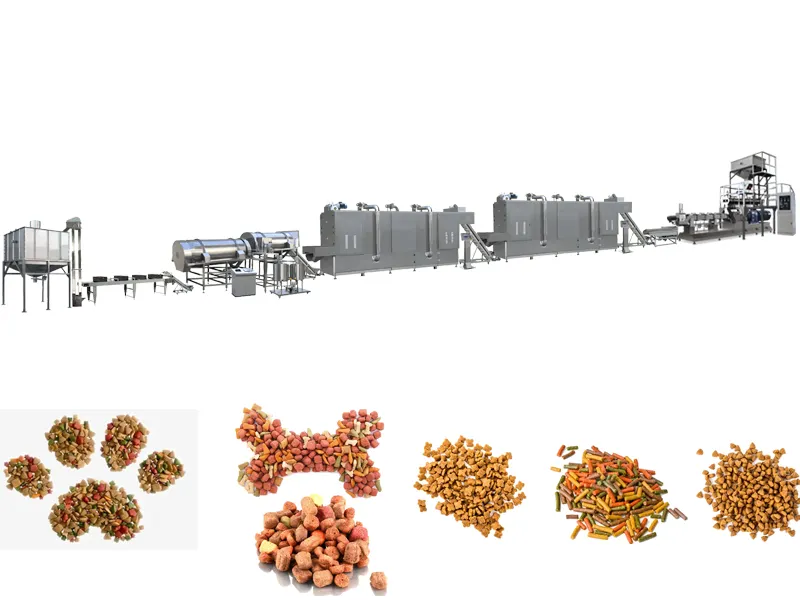
Optimizing Continuous Mixing Operations for Formula Uniformity
Achieving complete ingredient uniformity across massive production batches is a primary challenge in the modern pet food manufacturing sector. Premium companion animal diets often combine dry base grains, concentrated vitamin premixes, dense mineral blends, and high percentages of fresh slurries.
To prevent ingredient separation prior to extrusion, industrial plants utilize heavy-duty horizontal twin-shaft mixers designed for rapid, low-shear product dispersion. This specialized food production line machinery creates a homogeneous blend within minutes, ensuring that every individual kibble piece delivers identical nutritional values.
Automated load cell systems track ingredient weights in real time to prevent dosing errors during high-volume continuous processing cycles. This digital integration allows plant managers to audit material usage instantly, reducing expensive product tracking errors across complex manufacturing shifts.
Constructing mixers with food-grade stainless steel surfaces prevents cross-contamination and simplifies daily sanitation procedures. Smooth internal basin designs minimize physical ingredient retention, allowing processing crews to complete fast washdowns during product changeovers.
Quantitative Parameter Analysis of Commercial Extrusion Systems
Procurement managers must evaluate physical engineering parameters and utility consumption metrics when selecting new capital machinery for an expanding facility. The following data details the technical specifications and capacity ratings across various professional production setups engineered for modern food manufacturing.
| Extruder Model Designation | Operational Output Capacity | Main Driving Motor Power | Integrated Steam Injection Speed | Recommended Commercial Product Focus |
| MT-65 Twin Screw Array | 100 to 150 Kilograms Per Hour | 22 Kilowatts Total | 30 Kilograms Per Hour Maximum | Specialized Veterinary Diets and Trial Batches |
| MT-75 High Output Line | 300 to 500 Kilograms Per Hour | 45 Kilowatts Total | 80 Kilograms Per Hour Maximum | Standard Premium Dry Kibble and Cat Food |
| MT-85 Industrial System | 1000 to 1500 Kilograms Per Hour | 90 Kilowatts Total | 250 Kilograms Per Hour Maximum | High-Volume Multi-Plant Commercial Distribution |
Table 1: Technical Configurations and Output Benchmarks for Advanced Twin-Screw Pet Food Processing Lines.
Selecting the correct model configuration allows food companies to optimize their energy consumption per ton of finished product. Integrating matching pneumatic conveying systems and high-capacity automated cutting assemblies ensures smooth material movement without creating physical processing bottlenecks.
Advanced Drying and Liquid Coating Technologies for Enhanced Palatability
The manufacturing process does not end at the extruder die face, as wet kibbles contain high moisture levels that must be reduced. Passing the shaped product through a multi-layer circulating belt dryer removes internal moisture gently without causing surface cracks or geometric warping.
Controlling air velocity and temperature zones inside the dryer prevents the formation of a hard exterior skin that traps internal moisture. This technical precision keeps final water activity levels below safe thresholds, preventing mold growth and extending shelf life naturally.
Once the drying phase is complete, the kibble enters an automated vacuum coating drum to receive liquid fats and flavor enhancers. The vacuum pressure forces the liquid oils deep into the internal pore structure of the kibble, ensuring uniform flavor distribution.
If your plant engineering team requires professional technical layout drawings or an immediate quote for a customized production line, please contact our application specialists directly to review your project parameters.
Applying these lipid coatings via precise vacuum infusion prevents the final product from feeling greasy to the touch during packaging. This advanced step enhances product palatability, preserves structural integrity, and ensures a clean handling experience for the end consumer.
Hygienic Machinery Design for Regulatory Compliance and Safety
Maintaining strict sanitary conditions within a pet food production plant is essential for meeting international food safety standards. Modern manufacturing facilities must utilize specialized food processing industry machinery engineered from ground-up hygienic principles to eliminate bacterial harborage zones.
All product contact areas must feature polished stainless steel construction to prevent organic material accumulation and resist harsh chemical sanitizers. Eliminating square corners and exposed fasteners inside the processing stream prevents the dangerous buildup of salmonella or listeria strains.
Clean-in-place technologies allow operators to sanitize internal piping arrays and extrusion barrels without dismantling the entire mechanical framework. This automated cleaning approach shortens scheduled maintenance windows, lowers human labor requirements, and ensures consistent disinfection results.
Properly separating wet raw material areas from dried finished product zones prevents dangerous post-process cross-contamination within the facility. Implementing hygienic conveyor belts with integrated scraper systems keeps the entire plant floor clean during extended continuous production runs.
Scaling Production Versatility with Modular Die and Screw Components
Market preferences shift rapidly as pet owners demand unique product shapes, dual-texture treats, and specialized single-bite kibble dimensions. Traditional single-purpose machinery forces manufacturers to buy completely separate production assets to accommodate these evolving commercial trends.
Utilizing a highly adaptive pet food processing equipment array allows companies to swap modular die plates and screw segments within a single afternoon. This versatile setup enables a production line to transition from processing cat kibble to manufacturing premium dog treats.
Adjusting the screw combination alters the specific mechanical energy applied to the recipe, allowing successful processing of highly diverse ingredients. Operators can increase shearing forces for dense starches or lower processing pressures for high-meat formulations by rearranging the modular parts.
Investing in modular processing assets helps food enterprises maximize their initial capital efficiency and respond faster to seasonal market demands. This agility protects long-term market share and ensures high asset utilization rates across the entire corporate fiscal year.
Pet Food Manufacturing Operations FAQ
Why is a twin-screw extruder preferred over a single-screw model for premium pet food recipes?
Twin-screw extruders provide positive material displacement and superior mixing capabilities, allowing them to process complex formulas with high fresh meat content. They deliver precise control over shear forces and thermal energy transfer, preventing material accumulation inside the barrel channels.
How do operators calculate the optimal drying temperature for premium dry kibble?
Drying temperatures are calculated based on recipe moisture content, belt speed, and the specific density of the individual kibble pieces. Technicians balance the airflow to lower internal moisture below ten percent without scorching delicate vitamins or causing structural cracking.
What maintenance steps prevent extrusion barrel wear when running high-fiber alternative starch recipes?
Mechanics must inspect screw segment tolerances monthly and monitor the automated lubrication systems serving the primary thrust bearing assembly. Using hardened, abrasion-resistant alloys for barrel liners extends the service lifespan of components when running high-fiber pulse ingredients.
Can vacuum coating systems apply heat-sensitive probiotics onto the exterior surfaces of dry kibble?
Yes, vacuum coating systems are ideal for applying delicate liquid vitamins, fats, and post-extrusion probiotics onto dried kibble. The vacuum process infuses these heat-sensitive nutrients into the pores at lower temperatures, protecting beneficial microflora from thermal damage.
Brand Commitment: Meiteng Machinery
As a leading global provider of high-reliability food extrusion technology and specialized industrial machinery, Meiteng delivers robust processing solutions tailored for demanding manufacturing operations. We engineer and manufacture premium-grade twin-screw extruders, continuous drying ovens, and automated flavor coating systems designed to maintain optimal efficiency. By focusing on precision engineering, strict quality control, and adherence to international safety standards, our systems provide production teams with reliable performance. Beyond supplying world-class hardware, our technical team supports your staff with exhaustive material testing, custom factory floor layouts, and comprehensive engineering documentation. Fuyuan’s sister brand Meiteng is committed to being your trusted partner in food processing excellence, dedicated to driving your business growth through innovation.
References
- Association of American Feed Control Officials Pet Food Regulatory and Ingredient Frameworks: AAFCO Official Portal
- Institute of Food Technologists Advanced Food Extrusion and Thermal Processing Guides: IFT Knowledge Center
- Commercial Food Equipment Manufacturing Safety and Hygienic Design Standards: ANSI Authority