Industrial Analysis: Precision Oil Content Control & Closed-Loop Recovery Systems for Fried Puffed Pasta Snacks
July 1, 2026
For food manufacturers producing fried puffed pasta snacks—such as corn curls, fried twists, Doritos, Cheetos, fried flour crisps, and extruded puffed strips—the post-frying de-oiling procedure directly determines the finished product’s oil content, taste, shelf life, and production cost. Factory owners and production technicians frequently focus on two core questions:
- What exact percentage of residual oil can industrial de-oiling equipment stably control for fried puffed pasta snacks?
- Does the production line support a complete, closed-loop oil recovery and circulating drainage system?
1. Standard Controllable Oil Content Range After De-Oiling
Without de-oiling treatment, fried puffed pasta snacks freshly discharged from an industrial continuous fryer carry an exceptionally high oil content of 26%–30%.
By integrating professional industrial de-oiling equipment, the residual oil rate can be precisely managed via PLC frequency conversion speed regulation and programmatic time settings. The final target oil content varies significantly based on the equipment mechanism and the physical structure of the snack.
[ Raw Post-Fryer Pasta: 26%–30% Oil Content ]
       │
       ├─► Simple Vibration Screening ───► Residual Oil: 19%–25% (Surface oil only)
       ├─► Standard Centrifugal ────────► Residual Oil: 15%–22% (Mainstream industrial standard)
       └─► Vacuum Composite ────────────► Residual Oil: 12%–15% (Premium low-fat standard)
1.1 Conventional Continuous Centrifugal De-Oiler
Continuous centrifugal de-oilers are the standard baseline configuration for medium and large-scale puffed snack production lines. They are highly efficient for processing corn strips, fried small twists, flour crisps, and ordinary extruded puffed snacks. By adjusting the rotation speed (600–1200 rpm) and de-oiling duration (5–25 s), the finished oil content can be stably locked within a range of 15%–22%.
- Dense-Texture Fried Pasta (e.g., small twists, narrow flour strips): These products have excellent structural rigidity, allowing for stable residual oil control at 15%–17% after de-oiling. The result is a crisp, non-greasy bite that meets mainstream market standards.
- Loose, Porous Extruded Puffed Pasta (e.g., Cheetos, hollow corn curls): Due to their fragile, highly expanded structures, these snacks cannot withstand ultra-high centrifugal forces without crumbling. The oil content is typically balanced at 18%–22% to minimize product breakage rates during operation.
- Mass Production Benchmark: Most commercial factories calibrate their standard settings to achieve a finished oil content of 16%–18%, perfectly balancing flavor retention, raw material cost, and consumer demand for lower-fat snacks.
1.2 Vacuum Composite Centrifugal De-Oiler
High-end manufacturing lines targeting the premium “healthy/low-fat” snack sector deploy advanced three-stage vacuum centrifugal linkage de-oiling technology. Operating under a strong negative pressure of -0.08 MPa to -0.09 MPa, the vacuum environment completely eliminates the internal capillary negative pressure within the puffed pasta pores. This forces out deep-seated residual oil that standard atmospheric centrifugal machinery cannot reach.
For sheet-shaped puffed pasta—such as triangular corn tortilla chips and ultra-thin fried crisp slices—the finished oil content can be locked tightly between 12%–15%. This represents the lowest stable industrial oil threshold for fried starch-based snacks. Taking Doritos-style corn chips as an example, three-stage vacuum de-oiling yields a finished oil content of 14.2%–15.6%, reducing oil usage by up to 30% compared to single atmospheric centrifugal systems without sacrificing the product’s signature crispy mouthfeel.
1.3 Simple Vibration Screen De-Oiling
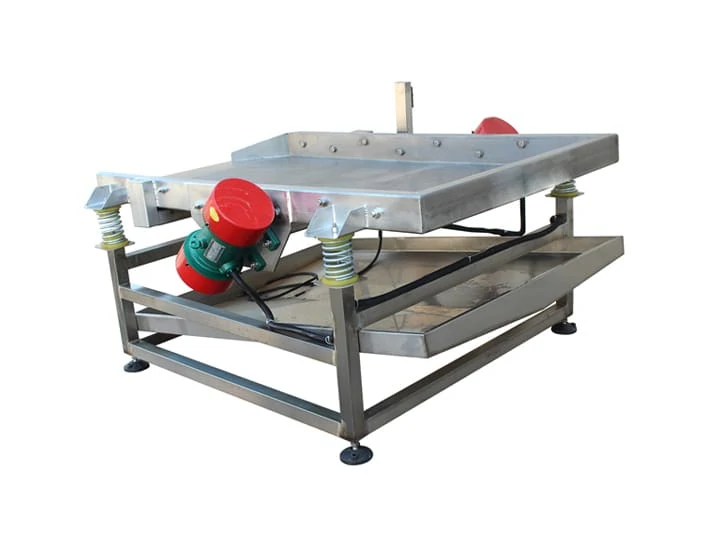
Low-budget, small-scale production workshops often rely strictly on vibrating screens to drain surface floating oil. Because this method applies zero centrifugal force, it fails to dislodge the oil trapped inside the internal pore network. This equipment can only reduce residual oil content to 19%–25%. It exhibits poor operational stability and significant batch-to-batch oil content fluctuations, making it suitable only for low-end markets with no strict nutritional or technical standards.
1.4 Global “Low-Fat” Product Compliance Threshold
According to general international food industry standards, fried snacks with a total finished oil content of $\le 18\%$ qualify to be labeled as lower-fat or controlled-fat products. High-precision centrifugal and vacuum de-oiling machinery fully satisfies these regulatory compliance requirements, whereas basic vibration setups cannot reliably hit these targets.
2. Key Factors Affecting De-Oiling Accuracy
Even when using top-tier de-oiling machinery, improper technical parameter synchronization can lead to an unexpected finished oil content deviation of 3%–5%. Three core variables dictate the final oil percentage:
- Product Tissue Macrostructure: Dense, thick fried pasta features a minimal internal pore network, limiting initial oil absorption and making it easier to drop the final oil level below 17%. Conversely, ultra-light, highly expanded products possess rich, sponge-like capillary pathways that shield trapped oil, requiring specialized vacuum cycles or extended processing durations.
- De-Oiling Operating Parameters: Mechanical rotation speed, total processing time, and feeding uniformity are the core adjustable parameters. While increasing the G-force (rpm) and extending runtime drives down residual oil, excessive centrifugal forces will shatter fragile puffed pasta shapes, spiking the factory’s scrap rate. Modern automatic systems solve this by utilizing one-click PLC parameter storage to lock in specialized recipes.
- Pre-De-Oiling Temperature Management: Fried puffed pasta must enter the de-oiling phase at an elevated temperature of 80°C–100°C. If the product is allowed to cool down along the conveyor system, the oil rapidly solidifies inside the pores due to surface tension, rendering it impossible to separate. This causes the final oil content to jump by 4%–7%. Standard modern lines use highly integrated, compact physical spacing to link the fryer directly to the de-oiler.
3. Complete Closed Oil Recovery & Circulation Drainage Systems
Modern industrial centrifugal and vacuum de-oiling units do not operate in isolation; they are fully integrated with closed-loop oil recovery and circulation filtration pipelines. This solves the manufacturing challenges of oil waste, rapid rancidity, and high overhead costs.

3.1 Full Circulation Process Workflow
- Extraction: Oil separated from the puffed pasta snacks drains immediately into a fully sealed, temperature-controlled oil collection tank integrated into the base of the de-oiler.
- Primary Filtration: The recovered liquid passes through a primary heavy-duty mesh filter to catch snack crumbs, loose starch deposits, and large solid particulates.
- Secondary Micro-Filtration: A secondary fine-pored filter intercepts minute carbonized and burnt organic particles, purifying the recovered oil before it can degrade.
- Re-injection: A food-grade, high-temperature oil pump automatically pumps the clean, clarified oil back into the main continuous fryer or an automated batch frying machine for immediate reuse.
- Smart Drainage: An independent waste-oil discharge valve and a dedicated storage tank are integrated into the pipeline loop. This allows the system to periodically purge highly oxidized oil with excessive acid values, preserving the flavor profile of the snack.
3.2 Core System Engineering Advantages
- High Oil Recovery Efficiency: The circulation system successfully reclaims 90%–95% of the separated surface oil. For large-scale mass production facilities, this slashes raw edible oil procurement costs by more than 12% annually.
- Extended Frying Oil Lifespan: Continuous online micro-filtration removes carbonized residues that act as catalysts for oxidation. Eliminating these residues slows down oil degradation and effectively doubles the operational lifespan of the frying oil batch.
- Sealed Environmental Hygiene: The fully closed pipeline layout eliminates oil atomization, oil mist splashing, and secondary workshop floor pollution. This guarantees strict compliance with rigorous international food safety and sanitary inspections.
- Intelligent Real-Time Monitoring: Advanced lines can be upgraded with online oil acid-value sensors. These sensors trigger an automatic alarm and execute automated waste-oil purging sequences the moment oil quality markers drift past acceptable thresholds, eliminating the need for manual sampling.
3.3 Production Line Compatibility Scope
The oil circulation and recovery system features a modular design that supports seamless engineering cross-docking. It can be paired directly with single centrifugal units, advanced vacuum composite systems, or large-capacity specialty lines like an automatic instant noodles fryer without requiring major structural retrofitting during field installation.
4. Equipment Selection Matrix Based on Target Oil Content
To assist engineering teams in procurement and system calibration, use the following application layout:
| Target Snack Type | Desired Oil Content | Recommended Equipment Configuration | System Advantages |
| Mass-Market Puffed Pasta (Twists, corn strips, standard flour crisps) | 16% – 18% | Continuous Centrifugal De-Oiler | High cost-to-performance ratio; highly stable throughput for resilient shapes; simple PLC recipe management. |
| Premium Low-Fat Snacks (Thin corn tortilla chips, fragile extruded slices) | 12% – 15% | Vacuum Composite Centrifugal System | Overcomes capillary pressure to extract deep oil; minimizes product breakage; locks in a “low-fat” market label. |
| Small-Scale / Low-Budget Workshop (Basic entry-level localized snacks) | 19% – 25% | Linear Vibration De-Oiling Screen | Minimal initial capital expenditure; drains easy surface oil; does not feature fine-filtration or auto-circulation. |
FAQ
Q1: Can the oil content of fried puffed pasta snacks be controlled below 10% after de-oiling?
A: No, this is not stably achievable for fried starch-based pasta at an industrial scale. Even with deep, multi-stage vacuum de-oiling, the oil that is chemically bound and absorbed deep inside the gelatinized starch matrix cannot be separated by physical force alone. The absolute minimum stable baseline for industrial frying production is 12%. If a brand requires an oil content below 10%, they should utilize a non-fried hot-air extrusion or baking production line instead.
Q2: Will the oil recycled by the circulation system negatively impact the snack’s flavor?
A: No. Because the recovery loop employs dual-stage continuous filtration, carbonized particles and micro-crumbs are extracted before they have time to scorch. The oil redirected back to the fryer remains pure and compliant with food-grade edible oil hygiene standards, preventing the development of bitter, burnt, or rancid off-flavors.
Q3: How long does it take to calibrate the de-oiling parameters to achieve a specific target oil percentage?
A: Modern automated de-oilers feature digital frequency drives linked to PLC systems. Initial calibration requires running only 1–2 testing batches. Once the optimal balancing point between rotation speed (rpm) and timer duration is reached, the recipe is stored in the system memory for consistent, long-term mass production.