


Rotary Head Extruder
Rotary Head Extruder is a single-screw extrusion machine designed for producing curled, twisted and specially shaped expanded snacks. Its rotary head extrusion system gives the machine a different forming principle from conventional food extruders, making it particularly suitable for Cheetos, Kurkure and other products that require twisting and curling during extrusion.
Unlike a standard die-and-cutter extruder that mainly pushes the material through a fixed die opening, the rotary head system uses rotating extrusion components to squeeze and twist the processed material before cutting. This creates the characteristic curled structure of products such as Cheetos and Kurkure.
The machine supports interchangeable molds and adjustable processing conditions, allowing different product shapes and sizes to be produced according to the selected configuration.
Meiteng can supply the Rotary Head Extruder as part of a complete Cheetos and Kurkure production line, including material mixing, extrusion, frying or baking, cooling, seasoning and packing.
Rotary Head Extruder Specifications
| Parameter | Specification |
| Machine Type | Single Screw Rotary Head Extruder |
| Main Application | Cheetos, Kurkure and curled extruded snacks |
| Extrusion Method | Rotary Head Extrusion |
| Mold System | Interchangeable Molds |
| Control | Frequency Control / Adjustable Process Parameters |
| Installed Power | See production-line configuration |
| Power Consumption | See production-line configuration |
| Output | 130–150 kg/h |
| Heating Method | Confirmed configuration |
| Screw Diameter | 70 mm |
| Screw L/D Ratio | 22:1 |
| Temperature Range | 60–160°C |
| Voltage | 380V / 50Hz / 3Ph or customized |
| Machine Dimensions | See selected line configuration |
| Main Material | Wear-resistant alloy steel / confirmed material |
| Screw Material | Wear-resistant alloy steel |
| Barrel Material | Wear-resistant alloy steel |
The listed output is based on Meiteng's current Cheetos and Kurkure extrusion-line configurations. Actual production capacity depends on raw material, moisture content, product specification and operating conditions.
Explore more food extruder.
| Model | Installed power | Power consumption | Output | Size |
| Fried Cheetos extruder line | 134kw | 94kw | 130-150kg/hr | 17x1.2x2.6m |
| Baked Cheetos extruder line | 76kw | 52kw | 130-150kg/hr | 15x1.2x2.6m |

Rotary Head Extruder Applications
The machine is particularly suited to products requiring rotary or curled extrusion.
Cheetos
Used as the forming core of fried or baked Cheetos production lines.
Kurkure
Suitable for producing curled corn-based snacks with the characteristic twisted structure.
Corn Curls
Can be configured for different curled profiles through mold selection and process adjustment.
Special-Shaped Extruded Snacks
Customized rotary-head and mold configurations can be considered for snack products requiring non-standard shapes.
The actual product range depends on the formulation and available rotary-head configuration.
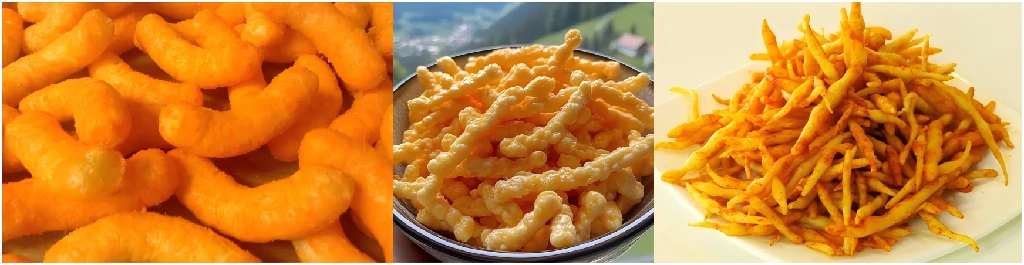
How Dose Rotary Head Extruder Work?
A rotary head extruder is an extrusion machine that uses a rotating head to form the material into a curled or twisted structure.
The raw material is first mixed and conditioned to the required moisture level. It then enters the extruder, where the single screw conveys and compresses the material. As the material reaches the rotary head, the rotating components squeeze and twist the material into the characteristic curled form.
The formed product is then cut to the required length before entering the frying or baking process.
The basic process is:
Mixing → Moisture Adjustment → Feeding → Screw Extrusion → Rotary Head Forming → Cutting → Frying / Baking → Cooling → Seasoning → Packing
This forming process is particularly important for Cheetos and Kurkure because the product's curled structure is created during extrusion rather than by simply cutting a straight extruded strand.
Rotary Head Forming Principle
The rotary head is the defining component of this machine.
During extrusion, the prepared corn-based material is compressed and forced through the rotary forming section. The rotation creates a twisting action while the material is being extruded.
This produces:
- Curled structures
- Twisted shapes
- Irregular snack forms
- Controlled product lengths
- Consistent product geometry
The forming result depends on the raw material, moisture content, extrusion conditions, rotary-head configuration, mold and cutting settings.
Why Rotary Forming Matters for Cheetos and Kurkure
Cheetos and Kurkure require a characteristic curved or twisted structure rather than a simple straight extrusion.
The rotary head provides the mechanical action needed to create this structure continuously.
This makes the machine particularly suitable for manufacturers whose main products are:
- Cheetos
- Kurkure
- Corn curls
- Twisted corn snacks
- Other rotary-formed extruded snacks
Meiteng's own description of its Kurkure/Cheetos process identifies the rotary head extruder as the core forming machine, with corn grits moisturized before entering the extruder and the rotary plates squeezing and twisting the material into curls.
Single Screw Extrusion System
The Rotary Head Extruder uses a single screw rather than the twin-screw configuration used in Meiteng's MT75 food extruder.
The screw performs the main conveying and compression functions before the material reaches the rotary forming section.
Screw Conveying
The screw continuously moves the prepared material toward the extrusion head.
Compression
As the material moves through the extrusion chamber, pressure builds progressively before the material reaches the forming section.
Extrusion
The compressed material enters the rotary head, where the rotating components create the required product structure.
Forming
The rotary movement produces the characteristic curled or twisted shape before the cutter determines the final product length.
This makes the extrusion mechanism closely connected to the final appearance of the product.
Interchangeable Mold System
The mold is one of the main components determining the final product shape.
Different mold configurations can be selected according to the required snack design.
Potential product formats include:
- Curls
- Twists
- Tubes
- Special-shaped snacks
- Customized snack profiles
Changing the mold allows the same extrusion platform to support different product specifications without replacing the complete machine.
The actual range of available molds depends on the rotary head configuration.
Cutting System
After the product is formed by the rotary head, the cutting system separates the continuous extruded material into individual pieces.
Cutting parameters can be adjusted according to:
- Product length
- Product diameter
- Expansion level
- Product shape
- Production speed
The relationship between the rotary head, mold and cutter is important for maintaining consistent product size.
A properly matched configuration helps reduce variations in product length and appearance during continuous production.
Raw Materials
The Rotary Head Extruder is mainly used with cereal- and starch-based formulations suitable for curled extruded snacks.
Typical raw materials may include:
- Corn grits
- Corn flour
- Maize-based formulations
- Cereal flour
- Starch-based ingredients
- Seasoning-compatible snack formulations
The raw material should normally be mixed and conditioned to the required moisture level before extrusion.
For Cheetos and Kurkure production, raw material preparation directly affects extrusion stability, product expansion, texture and final shape.
The final formulation should be confirmed according to the target product and production process.
Cheetos and Kurkure Production
The Rotary Head Extruder is particularly suited to Cheetos and Kurkure production because the rotary forming mechanism creates the characteristic curled structure.
A typical process includes:
Corn Grits → Mixing → Moisture Conditioning → Rotary Head Extrusion → Cutting → Frying or Baking → Cooling → Seasoning → Packing
The extrusion stage determines the basic shape and structure, while frying or baking develops the final texture and color.
Seasoning is then applied after cooling to produce different flavors.
Fried Cheetos Production
For fried Cheetos, the extruded curls are transferred to a frying system after cutting.
The typical process is:
Mixing → Rotary Head Extrusion → Cutting → Frying → De-oiling → Cooling → Seasoning → Packing
Meiteng currently lists a fried Cheetos extruder-line configuration with an output of 130–150 kg/h, 134 kW installed power, 94 kW power consumption, and an overall line size of approximately 17 × 1.2 × 2.6 m.
The final frying conditions depend on the product formulation, moisture content and desired texture.
Baked Cheetos Production
The Rotary Head Extruder can also be integrated into a baked Cheetos process.
The typical process is:
Mixing → Rotary Head Extrusion → Cutting → Baking / Roasting → Cooling → Seasoning → Packing
Meiteng currently lists a baked Cheetos extruder-line configuration with an output of 130–150 kg/h, 76 kW installed power, 52 kW power consumption, and an overall line size of approximately 15 × 1.2 × 2.6 m.
Compared with the fried configuration, the downstream thermal process is different, which results in a different overall line power requirement and equipment arrangement.
Fried vs Baked Cheetos Configuration
The same rotary-head extrusion principle can be used as the forming stage for both fried and baked Cheetos.
| Item | Fried Cheetos | Baked Cheetos |
| Output | 130–150 kg/h | 130–150 kg/h |
| Installed Power | 134 kW | 76 kW |
| Power Consumption | 94 kW | 52 kW |
| Line Size | 17 × 1.2 × 2.6 m | 15 × 1.2 × 2.6 m |
| Main Downstream Process | Frying | Baking / Roasting |
The different power and dimensions mainly reflect the downstream processing configuration rather than a different rotary-head forming principle.
Product Shape and Texture Control
Product appearance is affected by several process variables rather than the rotary head alone.
Important parameters include:
- Raw material particle size
- Formulation
- Moisture content
- Feeding stability
- Screw speed
- Extrusion pressure
- Rotary-head speed
- Mold design
- Cutting speed
- Frying or baking conditions
Changes in these parameters can affect expansion, density, curl, length and texture.
For this reason, product development should consider the complete extrusion process rather than selecting the machine only according to nominal output.
Frequency-Controlled Drive
The machine uses a frequency-controlled motor system to regulate operating speed.
Speed control allows the extrusion process to be adjusted according to the material and product requirements.
The operating speed affects:
- Material throughput
- Extrusion pressure
- Product formation
- Product density
- Production stability
The final operating parameters should be established during commissioning according to the selected product.
Wear-Resistant Extrusion Components
The extrusion system uses wear-resistant alloy steel for key working components.
The screw and barrel are exposed to continuous material contact and mechanical stress during production. Wear-resistant construction helps extend component service life under continuous operating conditions.
Replaceable Wear Components
Depending on the machine configuration, replaceable components may include:
- Screw
- Barrel components
- Rotary head components
- Molds
- Cutter blades
- Bearings
- Sealing components
Wear rates depend on raw material characteristics, production hours and operating conditions.
Electric Oil Circulation System
The Rotary Head Extruder uses an electric oil circulation system for lubrication of relevant bearing components.
Proper lubrication helps reduce friction and heat generation and supports longer bearing service life.
The lubrication system should be inspected according to the manufacturer's maintenance schedule.
Temperature and Moisture Control
Although the rotary head is responsible for the characteristic product shape, upstream material conditions have a direct effect on extrusion performance.
Moisture
Moisture content affects:
- Material flow
- Extrusion pressure
- Expansion
- Product density
- Texture
- Shape stability
The raw material should therefore be mixed and conditioned consistently before entering the extruder.
Temperature
Temperature Range: 60–160°C
The appropriate temperature depends on the formulation and extrusion process.
Temperature should be controlled together with moisture, screw speed and feeding rate rather than treated as an isolated setting.
Optional Configurations
The Rotary Head Extruder can be configured according to the target product and production process.
Possible configurations include:
- Different rotary-head configurations
- Interchangeable molds
- Customized product molds
- Adjustable cutting system
- Frequency-controlled drive
- Automatic feeding system
- Moisture-conditioning equipment
- Frying system
- Baking / roasting system
- Cooling system
- Seasoning system
- Automatic packing equipment
The final configuration should be determined according to the target product, required capacity and production process.
Installation Requirements
The Rotary Head Extruder should be installed on a stable, level production floor with sufficient space for operation, cleaning and maintenance.
The installation area should provide:
- Stable floor support
- Electrical power supply
- Ventilation
- Operator access
- Maintenance clearance
- Raw material feeding space
- Product discharge space
- Space for downstream frying or baking equipment
- Space for seasoning and packing equipment
Machine / Line Dimensions: 4650x1420x2150mm
For a complete Cheetos or Kurkure production line, the layout should be planned around the complete process rather than the extruder alone.
Maintenance Requirements
Regular maintenance is important because the extrusion system operates continuously under pressure, heat and mechanical load.
Daily Maintenance
- Clean residual material
- Clean the extrusion and cutting area
- Check the mold
- Inspect cutter operation
- Check abnormal vibration or noise
- Check material feeding
Routine Maintenance
- Inspect screw wear
- Inspect barrel condition
- Check rotary-head components
- Check bearings
- Inspect lubrication system
- Check cutter blades
- Inspect electrical connections
- Check frequency-control system
Product Changeover
When changing product specifications, the extrusion system should be cleaned and the mold and cutter checked before restarting production.
Main Wear Parts
Typical wear and replacement components include:
- Screw
- Barrel
- Rotary-head components
- Molds
- Cutter blades
- Bearings
- Seals
- Lubrication-related components
For high-volume production, keeping commonly used molds and cutter components as spare parts can reduce downtime during maintenance.
Production Capacity
The current Meiteng Cheetos/Kurkure configurations list an output of 120-150 kg/h for both fried and baked production lines.
Actual output can vary according to:
- Raw material formulation
- Moisture content
- Product diameter
- Product length
- Mold configuration
- Extrusion speed
- Frying or baking process
- Operating conditions
Capacity should therefore be confirmed against the target product rather than evaluated only from the nominal machine specification.
Rotary Head Extruder in a Complete Cheetos & Kurkure Line
The Rotary Head Extruder is normally used as the forming core of a complete Cheetos or Kurkure production system.
A typical line includes:
Raw Material Preparation → Mixing → Moisture Conditioning → Rotary Head Extrusion → Cutting → Frying / Baking → Cooling → Seasoning → Packing
For fried products, a continuous frying system follows the extrusion section.
For baked products, the extrusion output is transferred to a baking or roasting system instead.
Meiteng can configure the upstream and downstream equipment according to the target product, production capacity and processing method.
Rotary Head Extruder vs Conventional Food Extruder
The main difference is the forming mechanism.
| Feature | Rotary Head Extruder | Conventional Food Extruder |
| Main Forming Method | Rotary head twisting and extrusion | Die extrusion |
| Typical Product Structure | Curled / twisted | Expanded / shaped |
| Key Product Type | Cheetos, Kurkure, corn curls | Puffs, cereals, pellets and other extruded products |
| Mold | Interchangeable | Interchangeable |
| Core Forming Action | Squeezing + twisting | Extrusion through die |
| Main Advantage | Produces characteristic curled structures | Broader general extrusion applications |
This distinction is important when selecting equipment. A rotary-head machine should be selected when the product itself requires the characteristic curl or twist created during rotary extrusion.
About Meiteng Machinery
Meiteng Machinery specializes in the design and manufacture of industrial food equipment , including twin screw and single screw food extruders. With over 15 years of experience, our machines are exported to more than 50 countries, earning a reputation for quality, reliability, and energy-efficient performance. As a trusted provider of turnkey food processing solutions, we deliver high-performance equipment for snacks, cereals, pet food, and aquatic feed production.
Application

Pet Food Processing Line

Floating Fish Feed Production Line

Corn Puff Snacks Production Line

Breakfast Cereals Corn Flakes Production Line

Fortified Rice Production Line

Fried Snacks Processing Line

Textured Vegetable Protein Line

Baby & Nutritional Powder Processing Line

Cheetos & Kurkure Processing Line

Bread Crumb Production Line
