What Should Peruvian Snack Producers Consider When Choosing a Snack Food Production Line?
August 13, 2026
For Peruvian snack producers, the right snack food production line should match the product, raw materials, target output, energy conditions, and packaging plan. A suitable system must also support stable product quality and practical operation. This is especially relevant for businesses searching for snack food machine in Peru as the local market includes potato, corn, cereal, flour, and other snack categories. FAO classifies many of these products under cereal, flour, starch, potato, and root-based savoury snacks. Peru also has active opportunities for processed food development, including snacks made from agricultural products.
The equipment decision should therefore start with the production process rather than a machine price. A producer planning corn puffs needs different processing parameters from a company making filled curry puffs. The same principle applies to frying, extrusion, seasoning, drying, and packaging. A well-matched line can improve process control while reducing unnecessary equipment and operating complexity.
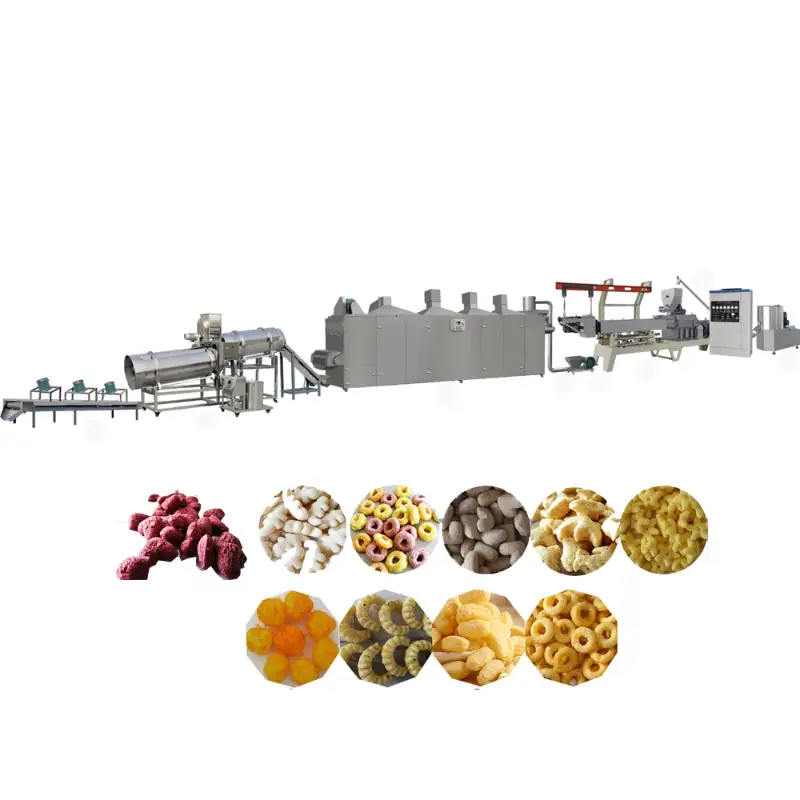
1. Why Does Product Type Determine the Machinery Configuration?
Snack production covers several process technologies. Extrusion works well for expanded cereal snacks, while forming and frying suit many filled or shaped products. Producers should define the final snack before selecting individual machines.
Extruded Corn and Cereal Snacks
Corn puffs require controlled mixing, extrusion, cutting, drying or frying, seasoning, and packaging. The extruder plays a central role because temperature, pressure, moisture, and screw configuration affect expansion.
A typical corn puff process may include:
- Raw material preparation
- Mixing and moisture adjustment
- Extrusion and shaping
- Cutting
- Drying or frying
- Flavoring and seasoning
- Cooling
- Weighing and packaging
For companies targeting expanded corn products, a dedicated puffed corn snacks making machine can integrate several stages into a coordinated production system.
The product formula also affects machine selection. Cornmeal, rice flour, wheat flour, potato ingredients, and composite formulations can behave differently during extrusion. Producers should therefore conduct trials before finalizing the screw design and process settings.
Filled and Formed Snacks
A curry puff uses a different production concept. The dough requires controlled preparation, forming, filling, sealing, and cooking. A curry puff line may also require filling equipment and dough handling systems.
A curry puff making machine can improve production consistency when manual forming becomes a bottleneck. The machine should maintain stable portion size and sealing quality. These factors directly affect product weight, appearance, filling distribution, and cooking performance.
2. What Should Buyers Check Before Selecting Snack Food Processing Machinery?
Equipment selection should consider production requirements beyond the headline capacity. A buyer should evaluate the complete process and identify potential bottlenecks.
Production Capacity
Capacity should match the company’s sales plan and available working hours. A machine rated for a certain output may produce less under a specific recipe.
For example, moisture content can influence extrusion performance. Product shape can also affect cutting speed and drying time. Therefore, buyers should confirm capacity using their actual formulation.
A practical evaluation should include:
| Selection factor | Key question for buyers | Why it matters |
|---|---|---|
| Product type | What snack will the line produce? | Determines the processing technology |
| Raw material | What ingredients will enter the process? | Affects mixing and extrusion conditions |
| Output | What hourly capacity is required? | Determines machine size |
| Product size | What shape and weight are required? | Influences forming and cutting |
| Cooking method | Frying, baking, or drying? | Defines downstream equipment |
| Seasoning | Dry seasoning or coating? | Determines flavoring equipment |
| Packaging | What pack sizes are planned? | Determines packing system |
| Expansion plan | Will capacity increase later? | Influences modular line design |
Caption: Key equipment selection factors for a commercial snack production line.
Factory Conditions
Peruvian buyers should also consider available factory space, electrical supply, water access, ventilation, drainage, and raw material storage.
Equipment layout can influence material flow and labor requirements. A compact line may benefit a smaller facility, while a larger plant may prioritize continuous material handling.
Factory conditions should be reviewed before purchasing. This prevents layout changes after equipment delivery.
Cleaning and Maintenance
Food equipment requires regular cleaning and inspection. Components that contact food should allow practical access for sanitation.
Maintenance also affects production continuity. Buyers should check access to wear parts, heating elements, cutting components, bearings, motors, and electrical controls.
A supplier should provide clear maintenance guidance. Operators should also understand which components require regular inspection.
3. How Can a Corn Puff Production Line Improve Process Consistency?
A corn puff production line relies on several connected stages. The extrusion process deserves particular attention because it determines the basic structure of the snack.
Extrusion Control
During extrusion, the material moves through a heated barrel under controlled pressure. The screw transports and processes the mixture before it reaches the die.
When the material exits the die, pressure drops rapidly. Moisture can vaporize and create expansion. This creates the characteristic porous structure found in many puffed snacks.
Small changes in moisture or temperature can influence expansion. Screw speed and die design also affect product shape.
For this reason, operators should monitor process variables instead of relying only on machine speed.
Drying and Seasoning
After extrusion, the product may require drying to reach the target moisture level. Proper drying supports texture stability and shelf-life management.
Seasoning comes after the product reaches suitable conditions. The seasoning system should provide consistent coverage without creating excessive waste.
Oil-based coatings and dry powders may require different application systems. The product formulation should determine the equipment configuration.
Packaging Integration
Packaging should not become an overlooked bottleneck. If the processing line produces 500 kg per hour but the packaging system handles only half that output, the entire line operates below its potential.
For this reason, equipment suppliers should evaluate processing and packaging as one production system.
4. Which Snacks Manufacturing Machine Configuration Fits Different Business Models?
A snacks manufacturing machine should reflect the producer’s product portfolio and business stage.
A startup may begin with one core product and moderate capacity. A larger processor may need several product formats and continuous operation.
Small and Medium Snack Producers
Smaller producers may prioritize flexible equipment. They may need to switch between formulas and product shapes.
A modular system can provide a practical solution. The producer can add downstream equipment as sales increase.
This approach can reduce the risk of investing in unused capacity.
Established Snack Manufacturers
Larger manufacturers may prioritize automation, throughput, process monitoring, and integration.
A continuous line can reduce manual handling between stages. Automated feeding and conveying can also improve material flow.
The right level of automation depends on labor availability, production volume, product complexity, and quality requirements.
Multi-Product Facilities
Companies producing several snack categories need greater process flexibility. Different products may require separate forming, extrusion, frying, drying, or seasoning systems.
The facility should therefore separate incompatible process requirements while maintaining efficient material movement.
This is where a broader range of food processing industry machinery can support different production stages and product categories.
For companies planning a new snack factory or upgrading an existing facility, contact Meiteng for snack processing equipment consultation.
5. What Should Peruvian Buyers Consider When Comparing Snack Food Machines?
Comparing machines only by purchase price can create problems later. The total production cost depends on several technical factors.
Energy Consumption
Heating, extrusion, frying, drying, and air handling can consume significant energy. Buyers should request operating parameters and understand the energy requirements of the complete line.
Energy efficiency depends on product formulation and operating conditions. Therefore, suppliers should provide realistic estimates based on the proposed configuration.
Labor Requirements
Automation can reduce manual handling. However, operators still need to manage feeding, quality control, cleaning, maintenance, and packaging.
The goal should not be maximum automation at any cost. The better target is an appropriate balance between automation, labor, output, and operational complexity.
Spare Parts and Technical Support
A production line depends on reliable replacement parts. Buyers should ask about spare part availability and recommended maintenance intervals.
Technical support also matters during installation and commissioning. Remote assistance can help solve routine issues, while on-site support may be necessary for complex installations.
For international buyers, communication should also cover installation instructions, electrical standards, documentation, and operator training.
Food Safety Requirements
Food-contact components should meet the required material and sanitation standards for the target market.
The equipment design should support cleaning and minimize areas where product residue can accumulate.
Buyers should also consider how raw materials move through the facility. Good process design reduces unnecessary contact and supports better production control.
6. How Should a Peruvian Snack Producer Plan a New Production Line?
A successful project usually begins with a clear product specification. The supplier can then recommend the processing sequence and equipment configuration.
Step 1: Define the Product
Specify the snack type, ingredients, shape, size, target weight, texture, and flavor.
For example, a corn puff requires extrusion parameters. A curry puff requires dough and filling control.
Step 2: Define Production Capacity
Calculate the expected daily and hourly output. Include planned operating hours and future growth.
Avoid selecting capacity based only on current demand. Consider whether the business expects new products or additional sales channels.
Step 3: Confirm the Factory Layout
Provide the supplier with available floor dimensions. Include ceiling height, entrances, utilities, storage areas, and packaging zones.
A production line should support logical material flow from raw materials to finished goods.
Step 4: Conduct Product Trials
Testing is especially important for extrusion-based snacks. The same machine may produce different results with different formulas.
Trials can help confirm expansion, texture, shape, output, and seasoning performance.
Step 5: Review the Complete Project Cost
The equipment quotation should not be the only financial reference.
Consider:
- Main processing equipment
- Auxiliary machines
- Conveyors
- Electrical installation
- Packaging equipment
- Spare parts
- Shipping
- Installation
- Training
- Maintenance
This approach gives buyers a clearer view of the investment.
FAQ
What is the main equipment used in a corn puff production line?
A typical line may include a mixer, extruder, cutter, dryer or fryer, seasoning machine, cooling conveyor, and packaging machine. The exact configuration depends on the product formula and required output.
Is a Puff snacks machine suitable for different raw materials?
Some extrusion systems can process different cereal or starch-based formulations. However, the suitable formula depends on the machine configuration. Buyers should conduct trials before commercial production.
What is the difference between a corn puff line and a curry puff line?
A corn puff line normally uses extrusion to create an expanded structure. A curry puff process focuses on dough preparation, filling, forming, sealing, and cooking. Their production technologies differ significantly.
How should I choose snack food processing machinery for Peru?
Start with product specifications, target capacity, raw materials, factory conditions, utilities, and packaging requirements. Then compare complete line configurations rather than individual machines.
Can one snack production line make multiple products?
Some systems can support multiple products through interchangeable dies, cutters, molds, or process settings. However, product compatibility depends on the machine design and formulation.
What should I ask a supplier before purchasing?
Ask about capacity, raw material compatibility, power requirements, installation, spare parts, maintenance, operator training, product trials, and after-sales technical support.
Is local raw material availability important?
Yes. Raw material consistency affects production stability. Peru has significant agricultural resources, and FAO reports opportunities for increasing value-added processing into products including snacks.
Why Choose Meiteng for Snack Processing Equipment?
Meiteng focuses on food processing equipment and complete production solutions for snack manufacturers. The company supports different snack processing requirements through equipment selection, line configuration, production planning, and technical consultation.
For buyers evaluating a snack food machine in Peru, the priority should remain practical: match the machine to the product, capacity, factory, and long-term production plan.
Meiteng can help customers evaluate these factors before selecting the appropriate snacks manufacturing machine. This approach supports more controlled investment decisions and helps manufacturers build production systems around their actual product requirements.
References
- Food and Agriculture Organization of the United Nations (FAO), Hand-in-Hand Initiative: Peru. FAO Peru Investment Forum and Agrifood Development
- Food and Agriculture Organization of the United Nations (FAO), Hand-in-Hand Initiative: Peru Success Story. FAO Peru Snack Industry and Native Potato Supply Chain
- Food and Agriculture Organization of the United Nations (FAO), GIEWS Country Brief: Peru. FAO Peru Food and Agriculture Data
- Food and Agriculture Organization of the United Nations (FAO), Food Category Classification. FAO Food Category Classification