High-Efficiency Textured Soy Protein Processing Line: Pre-Shipment Trial Run & Complete Solution Guide
July 29, 2026
The global plant-based protein market is expanding rapidly as food manufacturers respond to growing demand for meat alternatives, vegetarian products, and high-protein foods. Textured soy protein (TSP/TVP), also known as textured vegetable protein or soy protein chunks, has become a widely used ingredient due to its excellent protein content, fibrous texture, and versatility.
For manufacturers entering or expanding the plant-based protein sector, selecting a reliable production system is essential for achieving stable quality, efficient operation, and long-term profitability.
Recently, Jinan MT Machinery & Equipment Co., Ltd. successfully completed a pre-shipment trial run for its advanced textured soy protein processing line. The test verified the complete production process, including raw material feeding, twin-screw extrusion, shaping, drying, and cooling, ensuring the equipment was ready for customer installation and operation.
A professional TVP machine provides an integrated solution for producing soy protein chunks, flakes, and other textured protein products with consistent structure and quality.
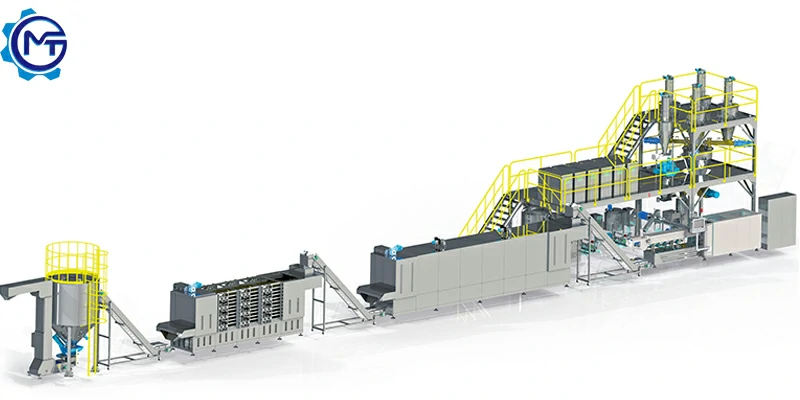
Complete Textured Soy Protein Production Process
A modern TSP/TVP production line combines automated material handling, extrusion cooking, shaping, drying, and cooling into one continuous system.
During the factory trial run, each production stage was tested to ensure stable equipment performance and reliable product output.
Step 1: Raw Material Preparation and Automatic Feeding
The process starts with accurate preparation of protein-based raw materials.
Common ingredients include:
- Defatted soy flour
- Soy protein isolate
- Wheat gluten
- Starch-based ingredients
The raw materials are transferred through automated conveying systems into the production line. Screw feeding technology ensures accurate dosing while reducing dust generation and improving the cleanliness of the production environment.
Stable feeding is especially important because fluctuations in material flow can directly affect extrusion pressure and final product texture.
Step 2: Twin-Screw Extrusion and Protein Texturization
The twin-screw extruder is the core technology behind textured soy protein production.
During extrusion, raw materials are exposed to controlled temperature, pressure, moisture, and mechanical shear. These conditions cause protein molecules to denature and reorganize, creating the fibrous structure required for meat substitute applications.
By precisely controlling extrusion parameters, manufacturers can achieve:
- Improved protein texture
- Uniform expansion
- Better rehydration performance
- Consistent product density
This stage determines the final eating experience of textured protein products.
Step 3: Die Forming and Precision Cutting
After extrusion cooking, the processed material passes through customized die plates to form different product shapes.
According to market requirements, the production line can manufacture:
- Soy protein chunks
- Textured protein flakes
- Protein strips
- Meat substitute pieces
The rotary cutting system adjusts speed according to extrusion output, ensuring consistent product dimensions and reducing material waste.
Step 4: Multi-Layer Drying and Moisture Control
After shaping, the freshly produced textured protein enters the drying section.
The multi-layer belt dryer uses controlled hot-air circulation to remove moisture evenly throughout the product.
Effective drying helps:
- Extend product shelf life
- Improve storage stability
- Prevent microbial growth
- Maintain texture after rehydration
For large-scale production, an efficient drying system plays an important role in reducing energy consumption and operating costs.
Step 5: Cooling and Final Packaging Preparation
After drying, the textured protein passes through a cooling conveyor to reduce temperature before packaging.
This prevents condensation during storage and ensures the final product remains stable during transportation.
The finished TSP products can then be collected for bulk packaging or further food processing applications.
Key Challenges in Textured Soy Protein Manufacturing
Producing high-quality textured protein requires precise control of extrusion and drying conditions. Many food manufacturers face challenges when upgrading their production capacity.
Challenge 1: Unstable Texture and Weak Fiber Structure
The quality of textured protein depends heavily on extrusion stability.
Incorrect temperature control, inconsistent feeding, or unstable pressure may result in:
- Loose internal structure
- Poor elasticity
- Uneven rehydration performance
A reliable extrusion system helps maintain consistent protein alignment and achieve a realistic meat-like texture.
Challenge 2: Feeding Problems and Production Interruptions
Protein powders can sometimes create feeding difficulties due to poor flow characteristics.
Unstable feeding may cause:
- Pressure fluctuations
- Extruder blockage
- Reduced production efficiency
- Increased maintenance requirements
Automatic feeding systems and optimized screw designs help maintain continuous operation.
Challenge 3: High Drying Costs and Uneven Moisture Removal
Drying is one of the most energy-intensive stages in textured protein production.
Traditional drying systems may experience uneven moisture distribution, especially when processing larger protein pieces.
An optimized dryer design improves airflow circulation and ensures consistent moisture reduction from the surface to the internal structure.
Why Choose Jinan MT Machinery for Textured Protein Production?
Jinan MT Machinery & Equipment Co., Ltd. develops industrial food processing solutions designed for reliable operation, flexible production, and long-term performance.
| Core Advantage | Production Benefit |
|---|---|
| Advanced Twin-Screw Extrusion Technology | Creates stable fibrous protein structures |
| Intelligent PLC Control System | Ensures accurate parameter management |
| Energy-Efficient Drying Technology | Reduces operating costs and improves moisture control |
| Complete Factory Trial Testing | Helps customers achieve faster installation |
Advanced Extrusion Technology for Better Protein Texture
Our twin-screw extrusion systems feature durable components and precise temperature control across different processing zones.
By optimizing extrusion conditions, the equipment helps manufacturers produce textured proteins with consistent fiber formation and excellent rehydration characteristics.
Intelligent Automation for Stable Production
The PLC-based control system monitors key production parameters, including:
- Screw speed
- Barrel temperature
- Feeding rate
- Cutting speed
Operators can easily adjust production settings through the touchscreen interface, improving efficiency and reducing manual errors.
Efficient Drying System for Lower Energy Consumption
The multi-layer drying system is designed with optimized airflow circulation and temperature distribution.
This ensures uniform drying performance while helping manufacturers reduce energy waste during continuous production.
Complete Pre-Shipment Testing Before Delivery
Before shipment, every production line undergoes a complete factory trial run.
The testing process evaluates:
- Equipment coordination
- Electrical stability
- Production capacity
- Finished product quality
This ensures customers receive a production system that is ready for installation and commissioning.
Build Your Plant-Based Protein Production Line with MT Machinery
Whether you are developing a new plant-based protein factory or upgrading an existing facility, Jinan MT Machinery provides complete solutions covering equipment design, manufacturing, installation support, and production guidance.
From customized production planning to factory testing and technical support, our team helps global customers build efficient textured soy protein production systems.
Contact Jinan MT Machinery today to discuss your TVP production requirements and receive a customized equipment proposal.