How To Make Corn Flakes: A Complete Guide to Industrial Production
December 24, 2025
Setting the Benchmark for Premium Corn Flakes Production
Corn flakes are more than just a breakfast staple. They are a benchmark product in the global cereal industry, where texture, consistency, and nutrition must align perfectly in every bite.
What defines a high-quality corn flake? Two things stand above all: a crisp, satisfying crunch and the ability to maintain structure even when soaked in milk. Consumers expect flakes that stay light yet firm, golden yet not burnt, and flavorful yet balanced.
For manufacturers, achieving this consistency at scale is no small feat. The industrial challenge lies in controlling every variable, from raw material quality to final roasting conditions. Each flake must exhibit uniform thickness, even color, and stable texture across thousands of kilograms of daily output.
This is where advanced processing solutions from Meiteng Machinery come into play. With integrated industrial food equipment, producers can transform raw corn into high-quality breakfast cereals with precision and efficiency.
Stage One: Raw Material Preparation & Mixing
The journey of a perfect corn flake begins long before extrusion. It starts with the careful selection and preparation of raw materials.
Selecting High-Quality Corn Grits
The foundation of corn flakes is degerminated cornmeal. Removing the germ ensures a longer shelf life and prevents rancidity, while also improving texture and processing stability.
High-quality corn grits should have:
- Uniform particle size
- Low fat content
- Minimal impurities
These factors directly influence the final product’s crispness and structural integrity.
Precise Recipe Formulation
Corn flakes are not just corn. A well-balanced formulation typically includes:
- Sugar for sweetness and browning
- Salt for flavor enhancement
- Malt extract for aroma and color development
- Vitamins and minerals for nutritional fortification
Accurate dosing is critical. Even slight variations can affect taste, texture, and appearance.
Moisture Conditioning
Water plays a subtle but powerful role. During pre-mixing, controlled water addition ensures even hydration of the corn particles.
Proper moisture distribution:
- Enhances starch gelatinization during extrusion
- Prevents uneven cooking
- Improves final texture
Too little moisture leads to poor expansion and brittle flakes. Too much creates sticky material that is difficult to process. Precision here sets the stage for everything that follows.
Stage Two: Core Process – Twin-Screw Extrusion
If the mixing stage is the overture, extrusion is the main performance.
Inside a twin-screw extruder, raw ingredients undergo a dramatic transformation under heat, pressure, and shear force.
High Temperature and Shear Transformation
As the mixture moves through the extruder, it is exposed to:
- Elevated temperatures
- Mechanical shear forces
- Controlled pressure
These conditions cause starch gelatinization and protein denaturation. The material transitions from granular powder into a cohesive, semi-plastic mass.
This transformation is essential for forming the structure required for flaking.
Multi-Zone Temperature Control
Modern extrusion systems use multi-zone temperature control to fine-tune the cooking process.
Each section of the barrel operates at a specific temperature, allowing precise control over:
- Degree of starch gelatinization
- Moisture retention
- Texture development
This level of control ensures that the extruded pellets have the ideal consistency for downstream processing.
Uniform Cutting and Shaping
At the die exit, rotary cutters shape the material into small, uniform pellets.
Consistency at this stage is critical. Uneven pellet size leads to irregular flaking and inconsistent roasting. High-precision cutting systems ensure that each piece enters the next stage with identical dimensions. With a professional corn flakes making machine, manufacturers can achieve precise cutting and stable shaping performance at scale.
Stage Three: Flaking & Toasting
This is where corn transforms into corn flakes, where engineering meets artistry.
Precision Flaking
Flaking machines use heavy-duty rollers to press the cooked pellets into thin flakes.
Key factors include:
- Roller gap control: Determines flake thickness with millimeter precision
- Surface temperature: Prevents sticking and ensures smooth flattening
- Cooling system: Keeps material stable during compression
Even slight deviations in roller spacing can result in flakes that are too thick, too thin, or structurally weak.
High-Temperature Toasting
After flaking, the product enters the toasting stage, a critical transformation point.
Here, heat triggers the Maillard reaction, a natural chemical process between amino acids and sugars. This reaction gives corn flakes their:
- Golden color
- Toasted aroma
- Complex flavor profile
Advanced ovens use hot air circulation systems to ensure even heat distribution. This prevents overcooking or undercooking, both of which can compromise product quality.
The result is a perfectly crisp flake that holds its structure in milk while delivering a satisfying crunch.
Stage Four: Coating & Drying (Optional)
For sweetened or flavored corn flakes, an additional coating stage is introduced.
Sugar Coating Technology
Liquid sugar or syrup is atomized and sprayed evenly onto the flakes. This creates a thin, uniform coating without clumping.
Precision spraying ensures:
- Even sweetness
- Consistent appearance
- Minimal waste
Secondary Drying
After coating, flakes undergo a second drying process to remove excess moisture and stabilize the coating.
This step:
- Prevents stickiness
- Extends shelf life
- Maintains crispness
The final product emerges glossy, flavorful, and ready for packaging.
Quality Control & Equipment Advantages
In cereal production, consistency is everything. A single deviation can affect entire batches.
Multi-Stage Quality Control
At Meiteng Machinery, quality assurance is embedded throughout the process:
- Raw material inspection before processing
- Real-time monitoring during extrusion and flaking
- Final product testing for texture, moisture, and appearance
This multi-layered approach ensures compliance with international food safety standards.
Advanced Equipment Design
Modern cereal processing equipment must combine durability with precision.
Key advantages include:
- Wear-resistant alloy screws for long service life
- Variable frequency drives for precise speed control
- Hygienic design with easy cleaning and optional CIP systems
Efficient cleaning is especially critical. Reduced downtime between production runs directly improves operational efficiency.
As in other industries where precision defines quality, consistency is non-negotiable. Much like how wholesale shoes suppliers rely on exact molds and standardized processes to ensure uniformity, cereal production demands the same level of engineering accuracy.
For manufacturers seeking scalable solutions, a fully integrated food manufacturing production line ensures seamless coordination between each stage, from mixing to packaging.
Partnering for High-Efficiency Corn Flakes Manufacturing
Producing high-quality corn flakes is not just about ingredients. It is about mastering a complex chain of processes where every parameter matters.
An efficient, well-designed production line is the foundation of high return on investment. It reduces waste, improves consistency, and enables product innovation.
Meiteng Machinery provides comprehensive solutions tailored to modern cereal manufacturers. From extrusion systems to complete processing lines, we help businesses stay competitive in a rapidly evolving market.
If you are planning to upgrade your cereal processing capabilities or launch a new product line, now is the time to act.
Looking to optimize your corn flakes production? Contact Meiteng Machinery today to get a customized, high-efficiency solution designed for your business.
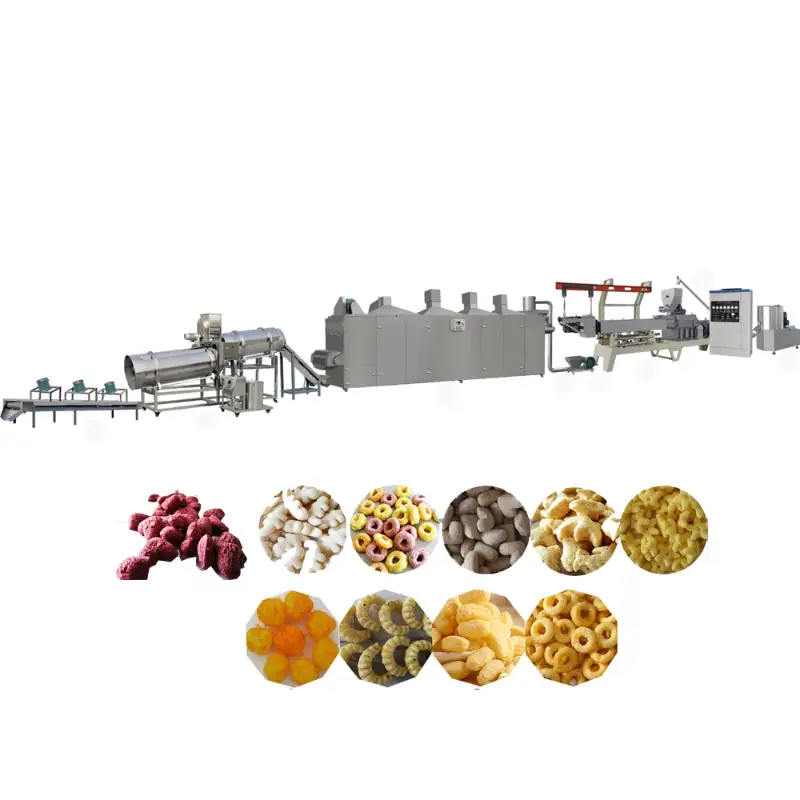
- The raw material of corn flakes are basically corn flour. Corn flakes production line is produced by us with years of quality, expertise and professionalism.
- The final products are crispy and the taste is good. The whole production line starts from material mixing, twin screw extrusion, flaking, drying, high temperature roasting, flavoring, drying, cooling and packing. By changing molds and the production process, this production line can make different shapes of puffed food. Such as ring, ball, flake, star, letter, etc.
As a professional extruded food equipment manufacturer, MT Machinery has become a production-study-research integrated supplier of extruded food solutions. According to customer requirements, we can provide customized solutions in line with their actual production, and realize the turnkey project of puffed food production equipment. The extrusion and puffing system is widely used in puffing snack food, breakfast cereal cornflakes food, plant protein meat food.
Our corn flakes production line characterizes by high efficiency, stable performance, MCC control system, large capacity.